Extended follow-up experiments — demographics, nesting, and residual CA
Secondary research questions — wave-2 Random Forests answering open memo questions
Project: PSYCH 755 — CA persona / PRCA framework
Analysis code: src/ca_personas/followup_experiments.py
CLI: ca-personas followup-experiments --join inner --seed 42
Artifacts: outputs/followup_experiments/
Agenda: docs/research_memo_agenda.md
Notebook: notebooks/secondary_rq_followup_experiments.ipynb
1 Motivation
Wave-1 secondary memos left specific uncertainties: unused Prolific demographics, country vs coordinates, whether Q28 survives conditioning on car access, whether CA adds signal beside mobility items, country×car interactions, Q27 usefulness within regular riders, fair common-N rankings, residual CA after ride-share stratification, and whether multiple imputation would restore demos/CA or attenuate Q28. Wave 2 implements nine offline experiments on the same matched cohort.
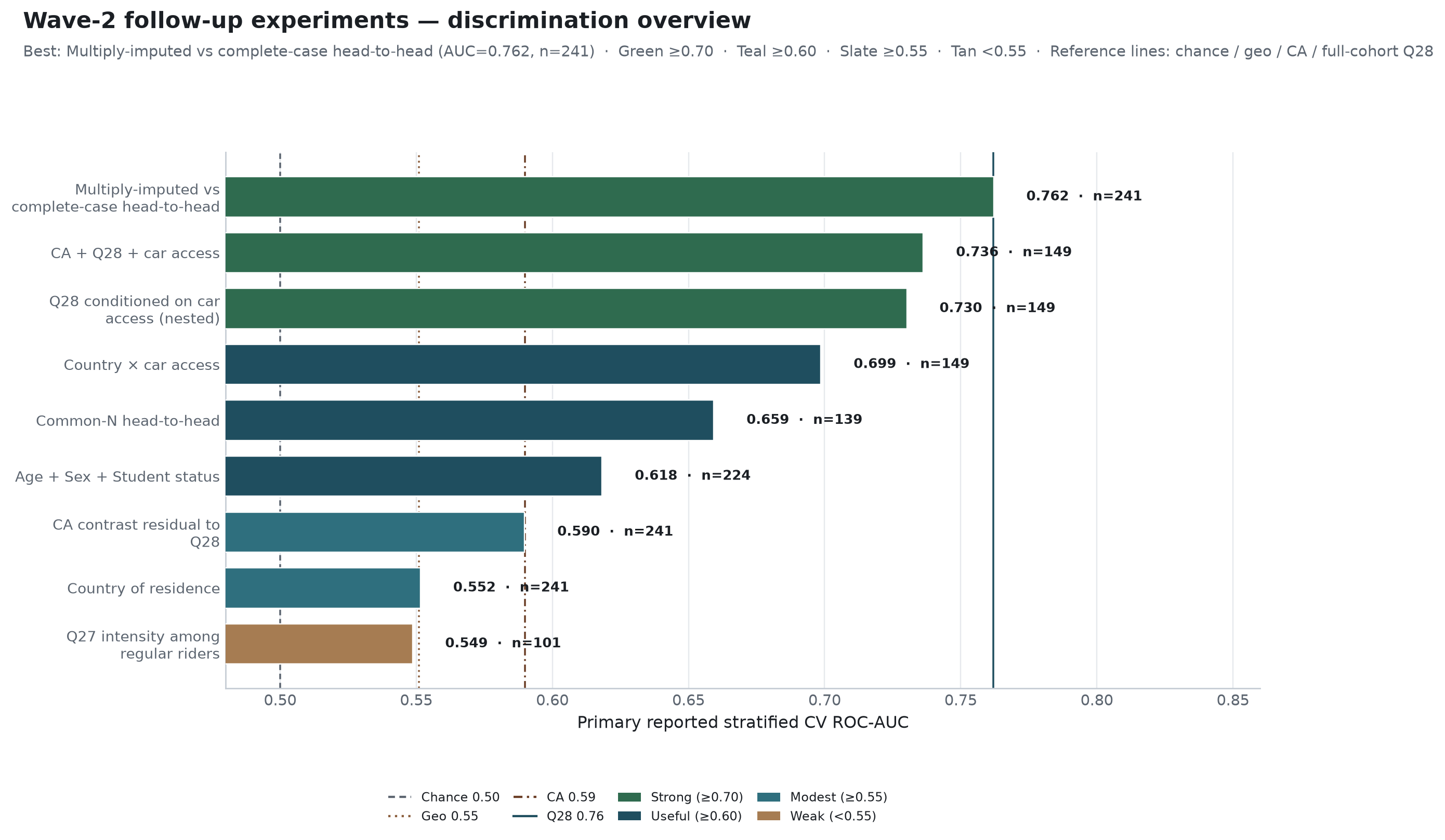
3 Results overview (seed 42)
| Experiment | Analytic n | Primary ROC-AUC | Interpretation |
|---|---|---|---|
| MI joint CA+Q28+car | 241 | 0.808 | Best MI joint; Q28 singleton lead preserved |
| CA + Q28 + car (joint CC) | 149 | 0.736 | Best joint complete-case model; mobility-dominated |
| Q28 | car (nested Q28+Q21) | 149 | 0.730 | Q28 retains lift; car adds incremental AUC |
| Country + car | 149 | 0.699 | Synergy over either alone |
| Common-N head-to-head (best = Q28) | 139 | 0.659 | Ranking robust to equal missingness |
| Demographics (Age+Sex+Student) | 224 | 0.618 | Modest; Age drives signal |
| Residual CA (CA-only on Q28 frame) | 241 | 0.590 | CA alone unchanged; +0.021 over Q28 when added |
| Country only | 241 | 0.552 | Ties lat/long geo |
| Q27 intensity among regular riders | 95–101 | 0.549 | No useful within-rider intensity classifier |
4 Experiment-by-experiment notes
4.1 Demographics → transit
Younger tertile ≈ 57% regular vs older ≈ 25%. Permutation importance: Age ≫ Sex ≫ Student. Students are sparse (n=34) after cleaning DATA_EXPIRED.
4.2 Country → transit
US 37% regular · UK 48% · Canada 60% (small n). AUC ≈ 0.552 matches the geo memo’s country-only baseline and lat/long RF—place labels and IP coordinates carry similar weak signal.
4.3 Nested Q28 | car (common n=149)
| Model | ROC-AUC |
|---|---|
| Q28 + Q21 | 0.730 |
| Q28 + Q20 + Q21 | 0.727 |
| Q28 only | 0.665 |
| Q21 only | 0.631 |
Q28 retains discrimination after car conditioning; car access adds ~0.07 AUC on the overlapping frame (where car items are non-missing).
4.4 CA + Q28 + car
On the car-complete subset, CA alone collapses (AUC ≈ 0.47) while Q28 (0.665) and Q21 (0.631) remain useful. Joint model 0.736; permutation importance ranks Q28 > Q21 > interpersonal CA > group CA.
4.5 Country × car
Additive country+car (0.699) slightly beats an explicit interaction feature (0.683) and clearly beats either alone.
4.6 Q27 among regular riders
Among 101 weekly+ riders, 35 (34.7%) report high intensity (≥3–4 rides/day). No candidate family exceeds AUC ≈ 0.55; intensity is not recoverable from CA, Q28, car, employment, or demos in this subgroup.
4.7 Common-N head-to-head (n=139)
Equal-complete-case ranking: Q28 (0.659) > country (0.619) > car (0.602) > geo (0.573) > employment (0.533) > CA (0.517) > demographics (0.511). Wave-1 “rideshare wins” is not an artifact of unequal N.
4.8 Residual CA after Q28
Overall transit→CA contrast replicates (group Δ ≈ −2.72, p < .001). Nested RF: Q28 AUC 0.762 → CA+Q28 0.783 (+0.021). Within Q28 strata, CA differences are heterogeneous (significant in Never and 0–1 days; near zero in 2–4 days).
4.9 Multiply-imputed vs complete-case head-to-head
M = 20 imputations of Q20/Q21/Student on n = 241. Singleton MI order: Q28 (0.762) ≫ demos (0.617) ≫ CA (0.590) ≳ car (0.562). Demographics/CA are not restored to competitive levels; Q28’s lead is not attenuated. Joint CA+Q28+car rises to 0.808 when car items are MI-filled on the full frame; standalone car weakens under MI (−0.045). See memos/mi_head_to_head.qmd.
5 Implications for persona tiers
- Ride-share days remain the dominant tabular mobility cue—even after car conditioning, common-N equalization, and multiple imputation of car/student items.
- Demographics (especially age) deserve attention in bias audits of the
demostier.
- Country and lat/long are interchangeable weak place cues.
- CA’s association with regular transit is largely redundant with Q28 for prediction, though the mean CA gap among riders remains descriptively real.
- Q27 intensity is not a useful secondary target among already-regular riders.
- MI expands joint mobility models to full N without letting demos/CA overtake Q28 as singletons.
6 Limitations
Complete-case shrinkage for car items (~149 / 139); MI assumes MAR given auxiliaries and uses simple code-rounding for categoricals; same-wave self-reports; convenience sample; AUCs are ranking metrics, not decision thresholds; within-stratum Welch tests are exploratory and underpowered in sparse Q28 cells.