Memo: Do CA scores add to Q28 and car access?
Research memorandum — joint psych + mobility Random Forest (complete-case)
Research question: On a complete-case frame, how do group/interpersonal CA ((McCroskey, 1970)), ride-share days (Q28), and car access (Q21) jointly and separately predict regular transit?
Companions: ca_scores_predict_transit.qmd · q28_conditioned_on_car.qmd · residual_ca_after_rideshare.qmd
1 Answer, Response, + Summary of Results
Complete cases for CA + Q28 + Q21 yield n = 149. Nested mixed Random Forests ((Breiman, 2001)) on this shared frame (seed=42):
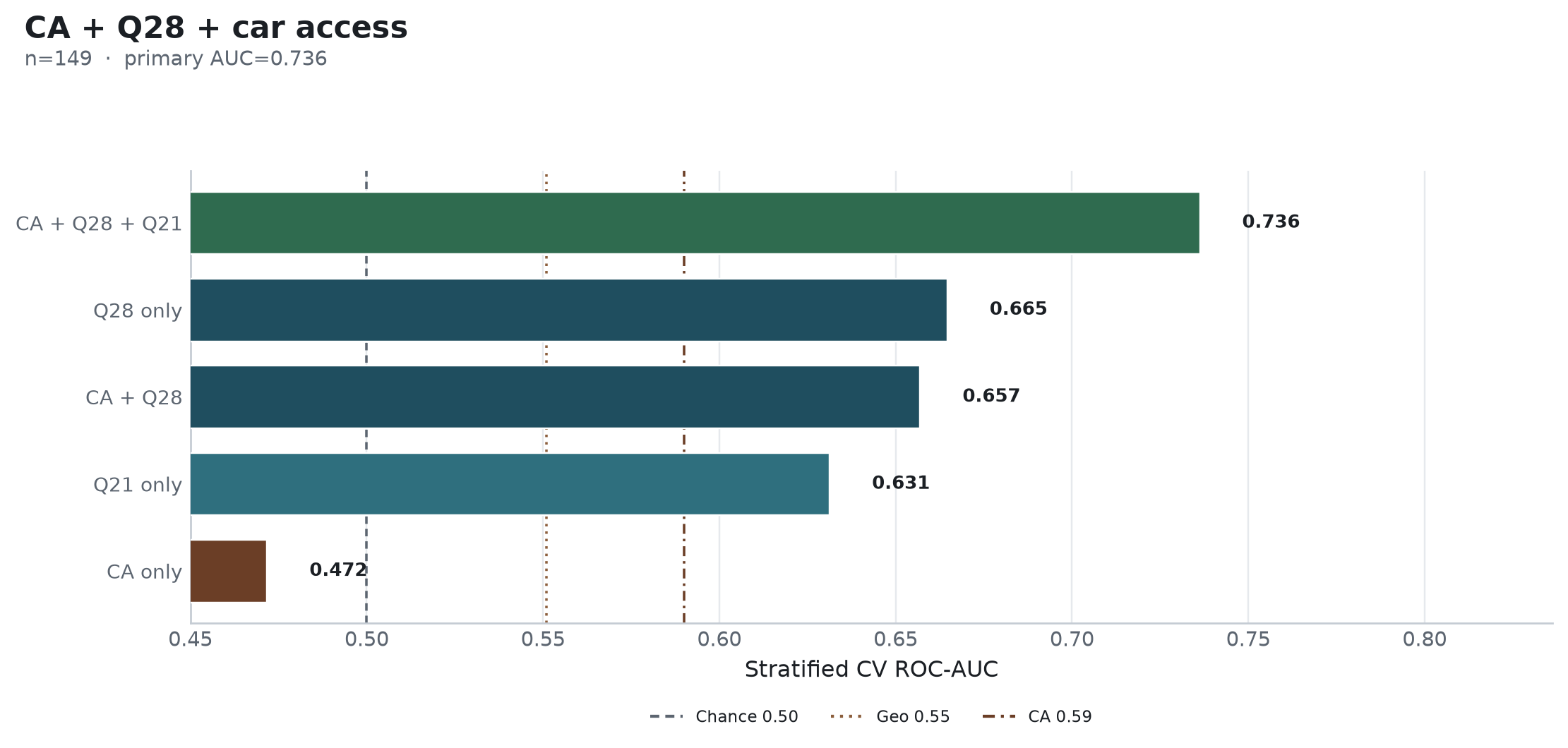
Short answer: The joint model is strong (AUC ≈ 0.736), but it is a mobility model—Q28 and Q21 dominate. CA alone on this subset is below chance (≈ 0.471), showing how sample restriction and mobility overlap can erase the modest full-cohort CA signal (≈0.590 on n=241). Figure Figure 1 shows the nested AUC comparison.
Q28 + car nested AUCs
1.1 Nested CV performance (common n = 149)
Table Table 1 reports the nested CV ROC-AUCs.
| Model | ROC-AUC |
|---|---|
CA + Q28 + Q21 |
0.736 |
Q28 only |
0.665 |
CA + Q28 |
0.657 |
Q21 only |
0.631 |
| CA only | 0.471 |
| Chance | 0.500 |
Permutation importance (joint model): Q28 ≈ 0.20 · Q21 ≈ 0.14 · interpersonal CA ≈ 0.08 · group CA ≈ 0.07.
1.2 Interpretation
- Answers the follow-ups memo’s psych-vs-mobility question without multiple imputation: mobility wins decisively on the overlapping frame.
- CA’s full-cohort AUC should not be compared naively to rideshare AUCs computed on different complete-case sets—CA collapses when the sample is the car-complete subset.
- Adding CA to
Q28alone does not beatQ28(0.657 < 0.665); CA helps only once car access is also present (joint 0.736).
Sources: ca-personas followup-experiments --experiments ca_q28_car · outputs/followup_experiments/ca_q28_car/ · formal write-up docs/secondary_rq_followup_experiments.md
2 What questions or uncertainties remain?
Is the CA collapse on n=149 selection (who answers car items) or true redundancy with mobility? See also residual-CA strata in residual_ca_after_rideshare.qmd.