Memo: Do country and car access jointly predict regular transit?
Research memorandum — country × car additive and interaction RFs
Research question: Do country of residence and car access (Q21) jointly—or as an interaction—predict regular public-transit use better than either alone?
Parent open question: transit_covariate_followups.qmd · Companions: country_predicts_transit.qmd · car_access_predicts_transit.qmd
1 Answer, Response, + Summary of Results
On respondents with complete country + Q21 (n = 149), nested categorical Random Forests ((Breiman, 2001)) (seed=42) show clear synergy.
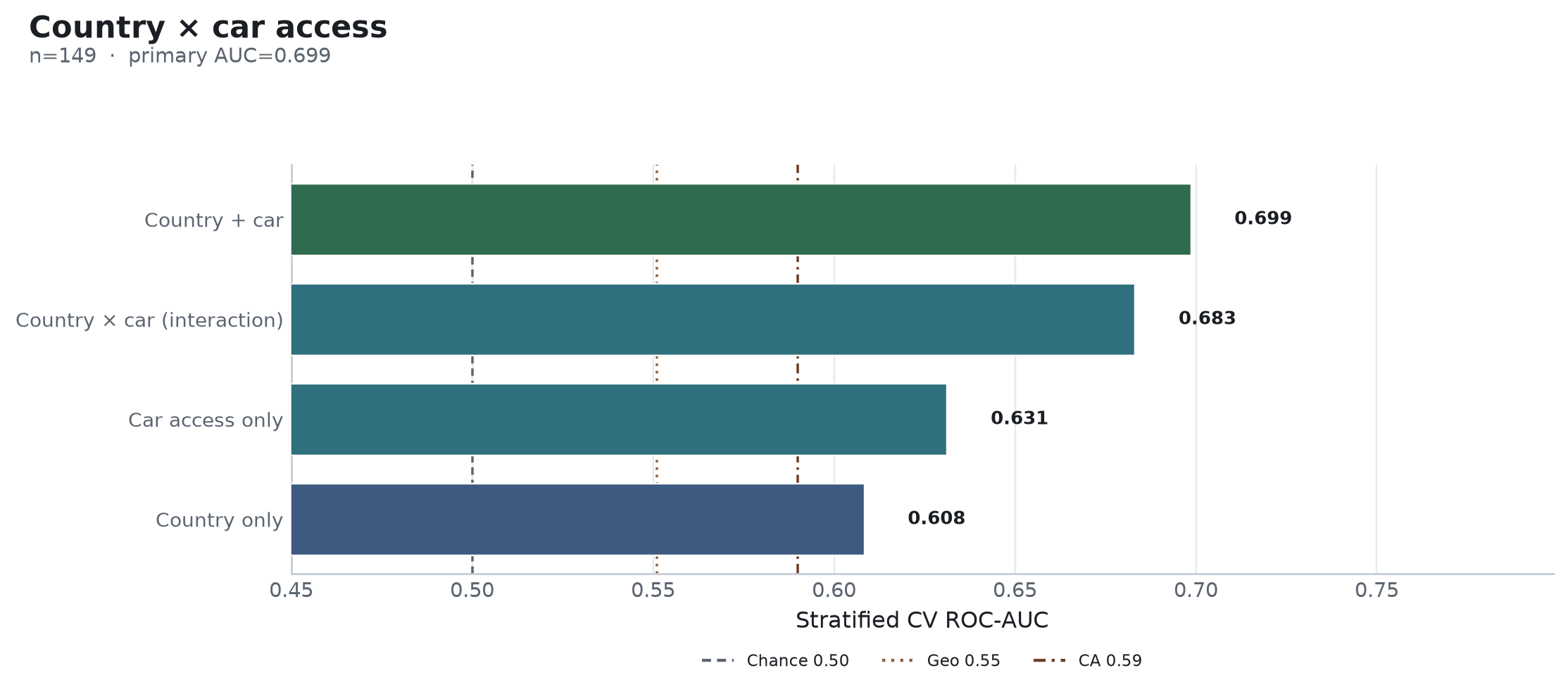
Short answer: Yes. Country + car AUC ≈ 0.699, beating car alone (0.631) and country alone (0.608). An explicit country × car interaction feature is similar but slightly weaker (0.683). Figure Figure 1 shows the AUC comparison.
1.1 Nested CV performance (common n = 149)
Table Table 1 reports the nested CV ROC-AUCs.
| Model | ROC-AUC |
|---|---|
| Country + car (additive) | 0.699 |
| Country × car (interaction string) | 0.683 |
Car access only (Q21) |
0.631 |
| Country only | 0.608 |
| Chance | 0.500 |
1.2 Interpretation
- Closes the follow-ups memo’s “country × car” open item: place and auto access are ****complementary****, not redundant.
- Additive encoding is sufficient; a saturated interaction string does not buy more AUC in this sample.
- Still far below full-cohort
Q28(≈0.762), so country×car is a mid-tier place/mobility bundle—not a rideshare substitute.
Sources: ca-personas followup-experiments --experiments country_car · outputs/followup_experiments/country_car/ · formal write-up docs/secondary_rq_followup_experiments.md
2 What questions or uncertainties remain?
Would denser geography (metro area / transit agency coverage) interact with car access more sharply than coarse country labels?