Memo: Do Age, Sex, and Student status predict regular transit?
Research memorandum — Prolific demographics as reverse predictors
Research question: Do Prolific demographics—Age, Sex, and Student status—predict regular public-transit use in the matched cohort?
Companion: country_predicts_transit.qmd · common_n_head_to_head.qmd · agenda docs/research_memo_agenda.md
1 Answer, Response, + Summary of Results
Using the Prolific↔︎Qualtrics matched analytic definition (weekly+ Q26; n = 224 with complete Age/Sex/Student after cleaning DATA_EXPIRED student values), we fit a mixed balanced Random Forest ((Breiman, 2001); Age numeric; Sex & Student one-hot) with stratified 5-fold CV (seed=42).
Short answer: Demographics are a modest but real predictor (CV ROC-AUC ≈ 0.618)—above chance (0.50), geo (≈0.55), and the CA benchmark (≈0.59). Age dominates; Sex and Student status contribute less. Figure Figure 1 shows the prevalence gradients and ROC curve.
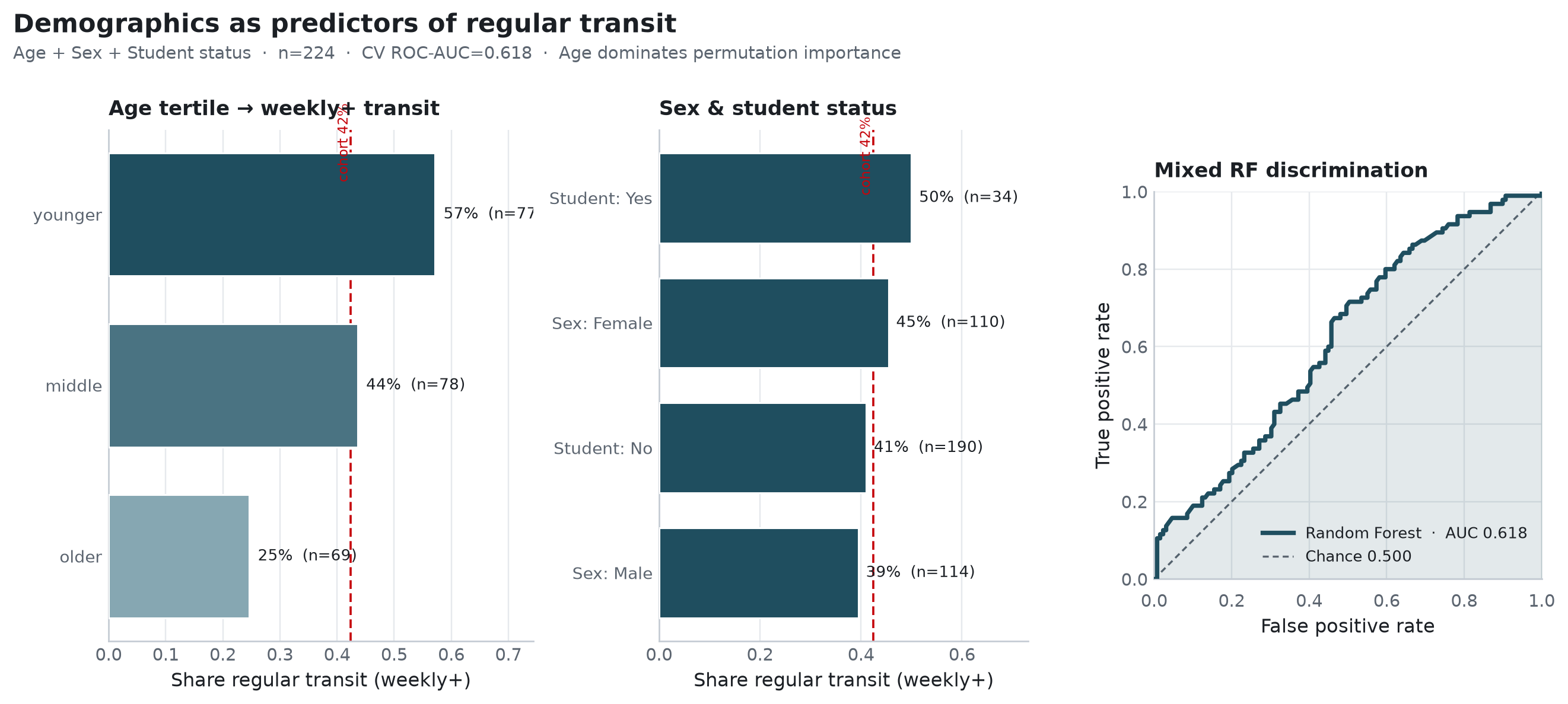
1.1 Prevalence gradients
Table Table 1 reports the prevalence gradients.
| Feature | Level | n | % regular |
|---|---|---|---|
| Age (tertile) | younger | 77 | 57.1% |
| Age (tertile) | middle | 78 | 43.6% |
| Age (tertile) | older | 69 | 24.6% |
| Sex | Female | 110 | 45.5% |
| Sex | Male | 114 | 39.5% |
| Student status | Yes | 34 | 50.0% |
| Student status | No | 190 | 41.1% |
1.2 Performance
Table Table 2 reports the CV performance.
| Model | n | ROC-AUC | Avg. precision | Balanced acc. | F1 |
|---|---|---|---|---|---|
| Age + Sex + Student | 224 | 0.618 | 0.544 | 0.567 | 0.515 |
| CA benchmark | 241 | 0.590 | — | — | — |
| Geo benchmark | 241 | 0.551 | — | — | — |
| Chance | — | 0.500 | — | 0.500 | — |
Permutation importance (AUC drop): Age ≈ 0.33 · Sex ≈ 0.13 · Student ≈ 0.06.
1.3 Interpretation
- The previously unused Prolific demographic block is not null for reverse transit prediction—younger respondents ride more.
- Student status, flagged as open in the covariate-followups memo, is too sparse (n=34 Yes) to carry much CV signal alone.
- For the primary LLM
demostier, age-linked error patterns are a plausible stereotyping surface even before employment/transit cues are added.
Sources: ca-personas followup-experiments --experiments demographics · src/ca_personas/followup_experiments.py · outputs/followup_experiments/demographics/
2 What questions or uncertainties remain?
Does age remain predictive after conditioning on Q28 and car access on a common-N frame? (Partially answered in common_n_head_to_head.qmd—demographics fall near chance when mobility items are forced into the overlap.)