Memo: Does country of residence predict regular transit?
Research memorandum — dedicated country RF vs lat/long geography
Research question: Does country of residence alone predict regular public-transit use, and how does it compare to Qualtrics lat/long geography?
Parent memo: geo_predicts_transit.qmd · Companion: country_car_predicts_transit.qmd
1 Answer, Response, + Summary of Results
On the full matched analytic cohort (n = 241), a categorical Random Forest ((Breiman, 2001)) on Country of residence yields CV ROC-AUC ≈ 0.552—essentially identical to the lat/long geo memo (≈ 0.551) and the geo module’s country-only baseline (≈ 0.549).
Short answer: Country is a weak place cue, interchangeable with survey coordinates for this outcome. It does not unlock the discrimination that mobility items (especially Q28) provide. Figure Figure 1 shows country prevalence and the ROC curve.
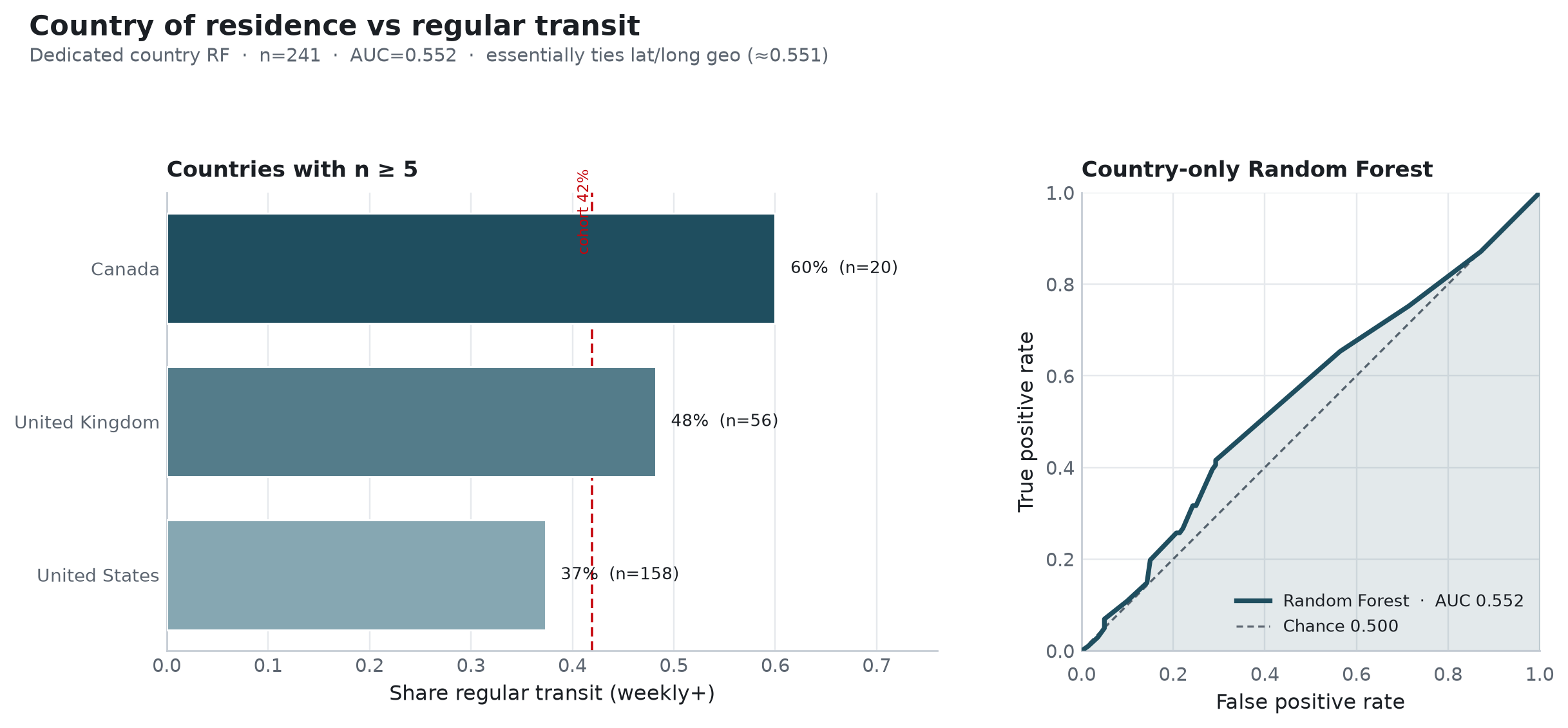
1.1 Prevalence by country (n ≥ 20)
Table Table 1 reports prevalence by country.
| Country | n | % regular |
|---|---|---|
| United States | 158 | 37.3% |
| United Kingdom | 56 | 48.2% |
| Canada | 20 | 60.0% |
Remaining countries are singleton / tiny cells and should not be over-interpreted.
1.2 Performance
Table Table 2 reports the CV performance.
| Model | n | ROC-AUC |
|---|---|---|
| Country of residence | 241 | 0.552 |
| Lat/long (geo memo) | 241 | 0.551 |
| CA benchmark | 241 | 0.590 |
| Chance | — | 0.500 |
1.3 Interpretation
- Answers the geo memo’s open question: ****country vs raw coordinates are tied****, both barely above chance.
- Place labels alone cannot explain the stronger rideshare/car associations.
- Pairing country with car access does help—see
country_car_predicts_transit.qmd.
Sources: ca-personas followup-experiments --experiments country · outputs/followup_experiments/country/ · formal write-up docs/secondary_rq_followup_experiments.md
2 What questions or uncertainties remain?
Would city-level or transit-infrastructure GIS features beat both country and IP lat/long? VPN/IP misplacement concerns from the geo memo still apply to the coordinate arm.