Memo: Does Llama-3.1–8B recover PRCA on prompt v1?
Research memorandum — full-cohort vLLM baseline (Terrarium 5-tier ladder)
Research question: Does meta-llama/Llama-3.1–8B-Instruct, when personified via prompt-v1 cumulative Terrarium narratives ((Argyle et al., 2023)), recover participants’ group and interpersonal PRCA scores — and do employment (RQ1), transit (RQ2), or full cumulative context (RQ3) reduce absolute error?
Formal write-up: docs/llm_baseline_llama31_v1.md
Cross-model memo: vllm_v1_cross_model_comparison.qmd
1 Answer, Response, + Summary of Results
Full-cohort vLLM run on the matched Prolific↔︎Qualtrics sample (n = 241; 1,205 prompts = 241 × 5 tiers; parse 100%). Host rogers-gpu-1.discovery.wisc.edu; fp8 Marlin weight-only on NVIDIA RTX A5000; export stamp 20260726_0221; throughput ≈ 12.3 samples/s.
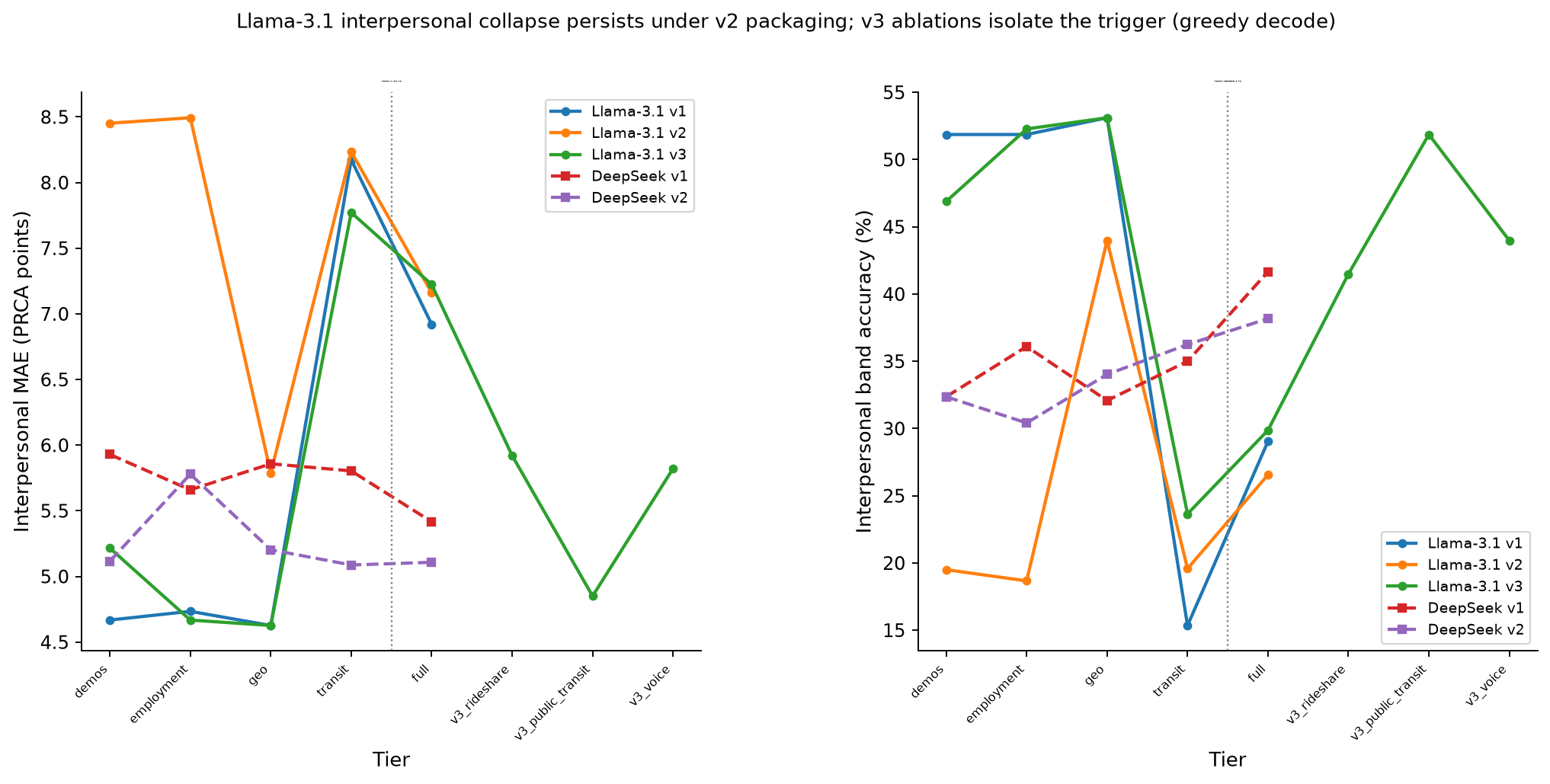
Short answer: Engineering success (valid CA JSON) but not a digital twin. Pooled MAE is 5.92 (group) / 5.82 (IP). Interpersonal bands succeed at demos/employment/geo (~52%), then collapse at transit (IP MAE 4.67 → 8.17; band 51.9% → 15.4%) via systematic over-prediction (signed IP error ≈ +6.5). Employment does not help. Best group MAE (5.68 at transit) still trails Ridge ML (≈4.49).
1.1 Overall vs chance / ML floor
Table Table 1 situates observed metrics against exact/band chance and the ML floor.
| Metric | Observed | Reference |
|---|---|---|
| Exact group / IP | 6.1% / 9.0% | ~4% exact chance |
| Band group / IP | 28.8% / 40.2% | ~33% band chance |
| MAE group / IP | 5.92 / 5.82 | ML floor group ≈ 4.49 |
1.2 Metrics by tier
Table Table 2 reports MAE and band metrics by tier.
| Tier | MAE G | MAE IP | Band G | Band IP | Mean err IP |
|---|---|---|---|---|---|
| demos | 6.05 | 4.67 | 25.7% | 51.9% | −2.21 |
| employment | 6.03 | 4.73 | 25.3% | 51.9% | −2.16 |
| geo | 6.02 | 4.63 | 25.3% | 53.1% | −2.31 |
| transit | 5.68 | 8.17 | 29.9% | 15.4% | +6.52 |
| full | 5.84 | 6.92 | 37.8% | 29.0% | +2.52 |
1.3 RQ verdicts
- RQ1 (employment): No — Δ MAE group −0.02; IP +0.07; bands flat.
- RQ2 (transit): Mixed / mostly no — small group MAE gain (−0.37) offset by catastrophic IP degradation (+3.51 MAE; −36.5 pp band).
- RQ3 (full): Mixed — group band rises to 37.8%; IP remains worse than demos-only.
Conclusion. Llama-3.1–8B-Instruct on prompt v1 behaves like a prior / stereotype engine that recovers coarse interpersonal bands from demographics alone, then over-weights mobility cues toward high interpersonal CA. Signed IP error flips from −2.21 (demos) to +6.52 (transit); DeepSeek on the same ladder stays flat. This failure mode motivated prompt packaging v2/v3 (signal-first transit text; subscale independence). v2 has been GPU-evaluated on Llama-3.1 (v2_enhanced; Rogers GPU; July 28) and Llama-3.2–3B (v2_enhanced; July 28). The v2_enhanced decode did not resolve the transit IP collapse on Llama-3.1 (transit IP MAE = 8.23 vs v1’s 8.17). v3 prior-greedy runs are archived on Llama-3.1, Llama-3.2–3B, and Llama-3.3–70B (July 29; 8 tiers). The pooled v2/v3 multi-model evaluation is committed (vllm_v2_v3_evaluation.qmd); only the canonical v3_enhanced decode refresh remains pending. Treat this memo as the canonical v1 cautionary baseline, not as evidence that larger Llama models are better digital twins on this task.
Figure Figure 1 plots Llama-3.1’s interpersonal MAE and signed error by tier against DeepSeek’s flat profile.
Sources: data/vllm/llama3_1.md · docs/llm_baseline_llama31_v1.md · evaluator ca_personas.evaluate · github.com/Exios66/psych755-jjb
2 What questions or uncertainties remain?
Does the transit IP collapse replicate under v2 packaging without changing model weights? Which demographic slices widen MAE gaps at transit (Sex / Age / Student / Employment stereotyping CSVs in the export package)? Would constrained decoding or lower temperature reduce over-prediction? Participant-level prediction histograms await staging of the gitignored raw export.
3 What other analyses pair with this memo?
Cross-model ranking: vllm_v1_cross_model_comparison.qmd. Smaller Llama and DeepSeek distill siblings: vllm_v1_llama32_3b.qmd, vllm_v1_deepseek_r1_distill.qmd. Prompt redesign: docs/persona_prompt_efficiency.md. Manuscript figure: memos/figures/vllm_v1_llama31_ip_collapse.png.