Memo: Does CA still separate riders after accounting for Q28?
Research memorandum — residual CA contrasts stratified by ride-share days
Research question: After accounting for ride-share days (Q28), does group/interpersonal CA still separate regular from non-regular public-transit riders?
Parent open questions: transit_riders_ca.qmd · ca_scores_predict_transit.qmd
1 Answer, Response, + Summary of Results
On Q28-complete rows (n = 241), we (i) replicate the overall transit→CA (McCroskey, 1970) Welch contrast, (ii) compare nested RFs ((Breiman, 2001); CA only / Q28 only / CA+Q28), and (iii) run within-Q28-stratum Welch tests.
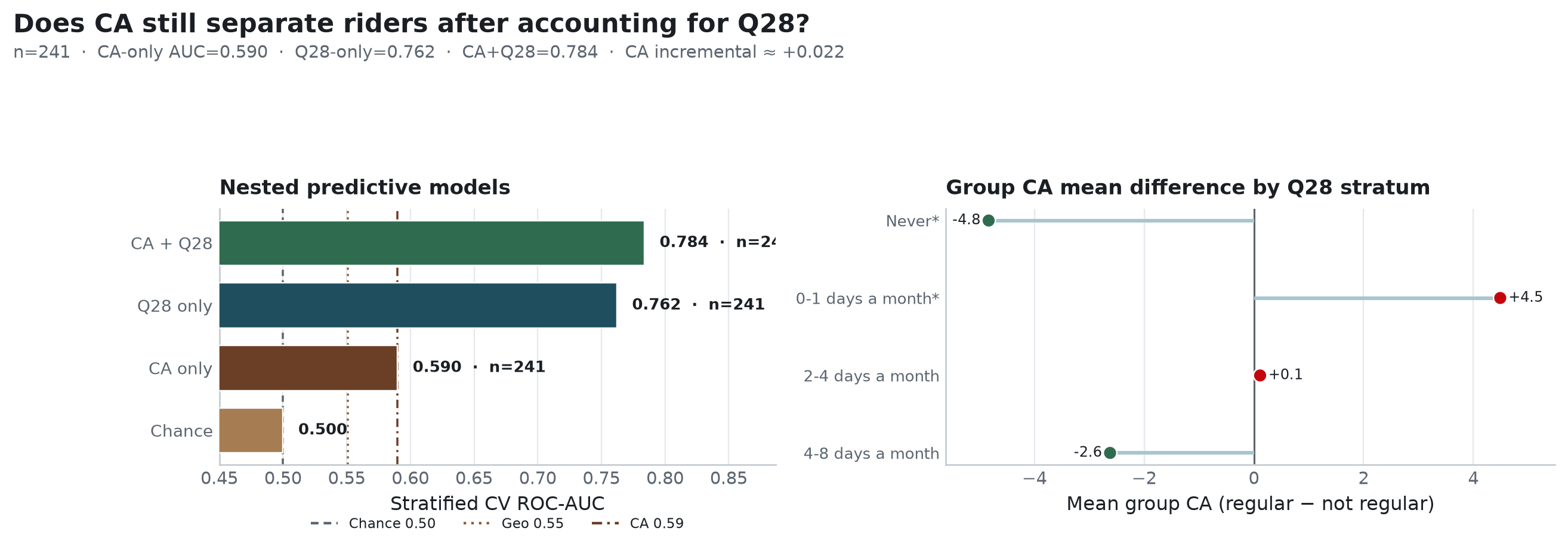
Short answer: The mean CA gap among regular riders remains real overall, but for prediction CA adds almost nothing once Q28 is present (+0.021 AUC). Within Q28 strata, CA differences are heterogeneous—sometimes reversed (Figure Figure 1).
1.1 Overall transit → CA (replication)
Table Table 1 reports the overall transit → CA Welch contrasts.
Q28.
| Score | Mean regular | Mean not | Δ | Cohen’s d | Welch p |
|---|---|---|---|---|---|
| Group CA | 13.04 | 15.76 | −2.72 | −0.46 | <.001 |
| Interpersonal CA | 13.31 | 15.04 | −1.73 | −0.30 | .020 |
1.2 Nested predictive models
Table Table 2 reports the nested predictive models.
| Model | ROC-AUC |
|---|---|
CA + Q28 |
0.783 |
Q28 only |
0.762 |
| CA only | 0.590 |
| Chance | 0.500 |
CA incremental over Q28 ≈ +0.021.
1.3 Within-Q28 strata (exploratory)
Table Table 3 reports the within-Q28-stratum contrasts.
Q28 level / Group CA Δ (reg − not) / Welch p.
Q28 level |
Group CA Δ (reg − not) | Welch p | Note |
|---|---|---|---|
| Never | −4.83 | .006 | Regulars lower CA |
| 0–1 days/month | +4.49 | .033 | Regulars higher CA |
| 2–4 days/month | +0.11 | .92 | Null |
| 4–8 days/month | −2.62 | .22 | Underpowered |
| 8+ days/month | — | — | Nearly all regular |
1.4 Interpretation
- Third-variable concern from the transit→CA memo is partly justified for prediction:
Q28absorbs most ranking signal.
- The descriptive CA gap is not a pure
Q28artifact—contrasts persist in the Never stratum—but the 0–1 days reversal warns against a single global CA–transit story.
- For persona-tier design, ride-share exposure remains the higher-value mobility cue; CA should not be treated as an independent transit classifier once
Q28is known.
Sources: ca-personas followup-experiments --experiments residual_ca_q28 · outputs/followup_experiments/residual_ca_q28/ · formal write-up docs/secondary_rq_followup_experiments.md
2 What questions or uncertainties remain?
Are stratum reversals stable under alternate Q28 groupings or a formal interaction model (CA × Q28)? Larger samples would be needed for confirmatory stratum-wise inference.