Memo: Does Q28 retain predictive lift after car access?
Research memorandum — nested Q28 | car Random Forests on a common complete-case frame
Research question: Does ride-share days (Q28) retain predictive lift for regular transit after conditioning on car access (Q21 / Q20)?
Parent: q27_q28_predict_transit.qmd · Companions: car_access_predicts_transit.qmd · ca_mobility_joint_predicts_transit.qmd
1 Answer, Response, + Summary of Results
We restrict to respondents with complete Q28 + Q20 + Q21 (n = 149; 58 regular) so nested models share one sample, then compare stratified CV Random Forests ((Breiman, 2001); seed=42).
Short answer: Yes—Q28 retains lift, and car access adds incremental discrimination. On the common frame, Q28 alone AUC ≈ 0.665; Q28+Q21 rises to ≈ 0.730 (+0.066). Q21 alone is ≈ 0.631 (Figure Figure 1).
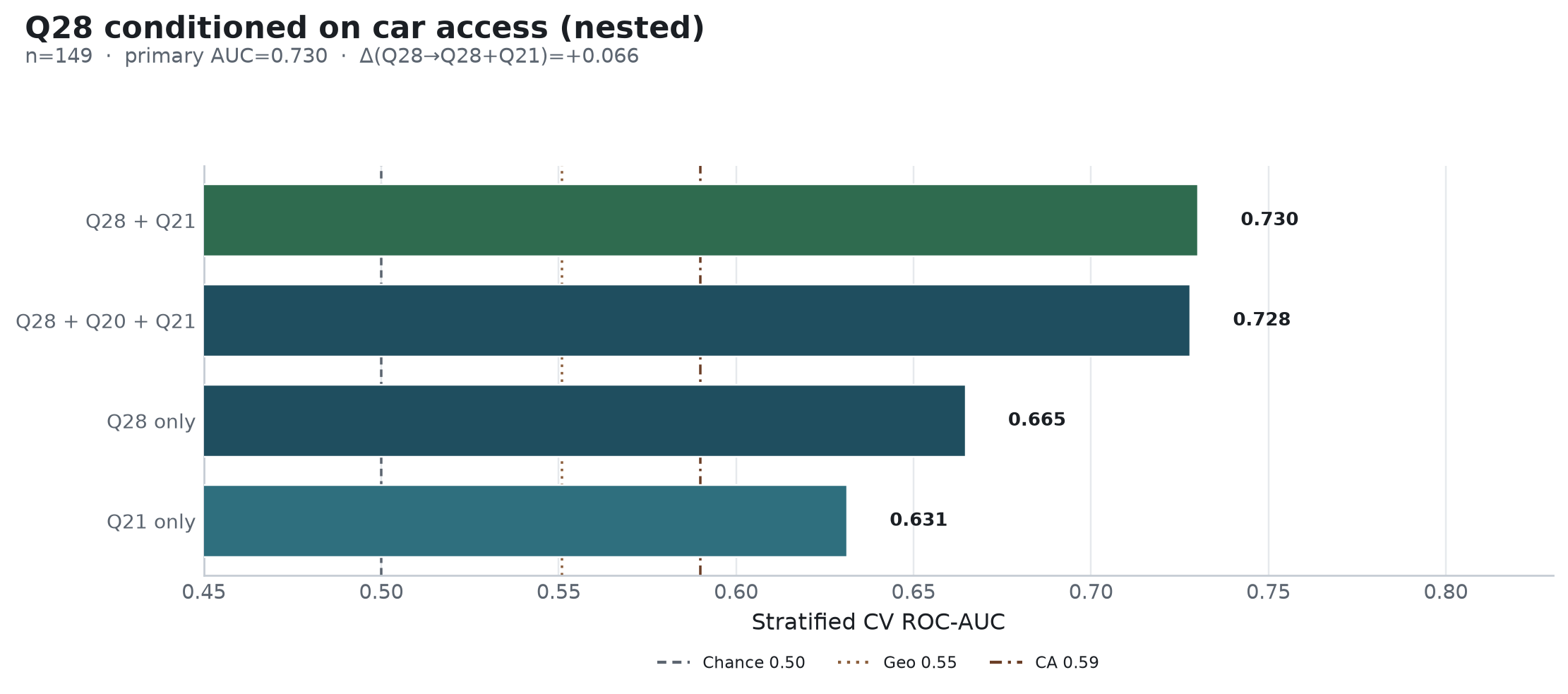
Q28|car AUC comparison
1.1 Nested CV performance (common n = 149)
Table Table 1 reports the nested CV performance on the common sample.
Q28 conditioned on car access.
| Model | ROC-AUC | Avg. precision | Balanced acc. | F1 |
|---|---|---|---|---|
Q28 + Q21 |
0.730 | 0.580 | 0.746 | 0.701 |
Q28 + Q20 + Q21 |
0.727 | — | — | — |
Q28 only |
0.665 | — | — | — |
Q21 only |
0.631 | — | — | — |
| Chance | 0.500 | — | 0.500 | — |
Permutation importance in Q28+Q21: Q28 mean \(\Delta\)AUC ≈ 0.15 · Q21 ≈ 0.13.
1.2 Interpretation
- Directly answers the
Q27/Q28memo’s open question:Q28is not merely a proxy for lacking a car—both cues matter on the overlapping sample.
- Full-cohort
Q28AUC (≈0.762 on n=241) shrinks to 0.665 when forced onto car-complete rows; missingness still matters for absolute AUC, but the relativeQ28>car ordering holds.
- Adding license (
Q20) on top ofQ28+Q21does not help (0.727 ≈ 0.730).
Sources: ca-personas followup-experiments --experiments nested_q28_car · outputs/followup_experiments/nested_q28_car/ · formal write-up docs/secondary_rq_followup_experiments.md
2 What questions or uncertainties remain?
Would multiple imputation of Q20/Q21 recover the full-cohort Q28 AUC while preserving the incremental car effect?