Memo: Do v1 vLLM models recover PRCA as digital twins?
Research memorandum — cross-model comparison on prompt-v1 Terrarium tiers
Research question: Across full-cohort vLLM runs on the same prompt-v1 five-tier ladder (demos → employment → geo → transit → full), which open-weight instruct / distill models best recover ground-truth PRCA group and interpersonal scores — and do employment, transit, or cumulative context reduce absolute error (RQ1–RQ3)?
Formal method pages: docs/llm_baseline_llama31_v1.md · docs/llm_baseline_llama32_instruct_v1.md · docs/llm_baseline_deepseek_r1_distill_v1.md · docs/llm_baseline_llama33_70b_v1.md · docs/persona_prompt_versions.qmd
Sibling memos (per model): vllm_v1_llama31_8b.qmd · vllm_v1_llama32_3b.qmd · vllm_v1_deepseek_r1_distill.qmd · vllm_v1_llama33_70b.qmd
1 Answer, Response, + Summary of Results
Using the Prolific↔︎Qualtrics matched analytic cohort (n = 241; inner join; complete scorable PRCA), we evaluated four GPU vLLM exports on identical prompt-v1 Terrarium narratives (241 × 5 tiers = 1,205 prompts each; Table Table 1):
| Model | Tag / export | Parse | Hardware / notes |
|---|---|---|---|
meta-llama/Llama-3.1–8B-Instruct |
20260726_0221 |
100% | fp8 Marlin WO · A5000 · 12.3 samp/s |
meta-llama/Llama-3.2–3B-Instruct |
20260726_0252 |
100% | ~21.0 samp/s |
deepseek-ai/DeepSeek-R1-Distill-Llama-8B |
20260726_0324 |
99.8% (1202/1205) | fp8 Marlin WO · 1.34 samp/s · </think> strip |
meta-llama/Llama-3.3–70B-Instruct |
llama_70b.csv |
100% | Mode collapse — only 8 unique generations |
Metrics follow the project evaluator (ca_personas.evaluate): MAE / exact match / band accuracy on group & interpersonal PRCA (6–30; bands low≤13 / moderate 14–19 / high≥20). Classical ML floor for comparison: best transit group MAE ≈ 4.49 (Ridge; docs/ml_baselines.md).
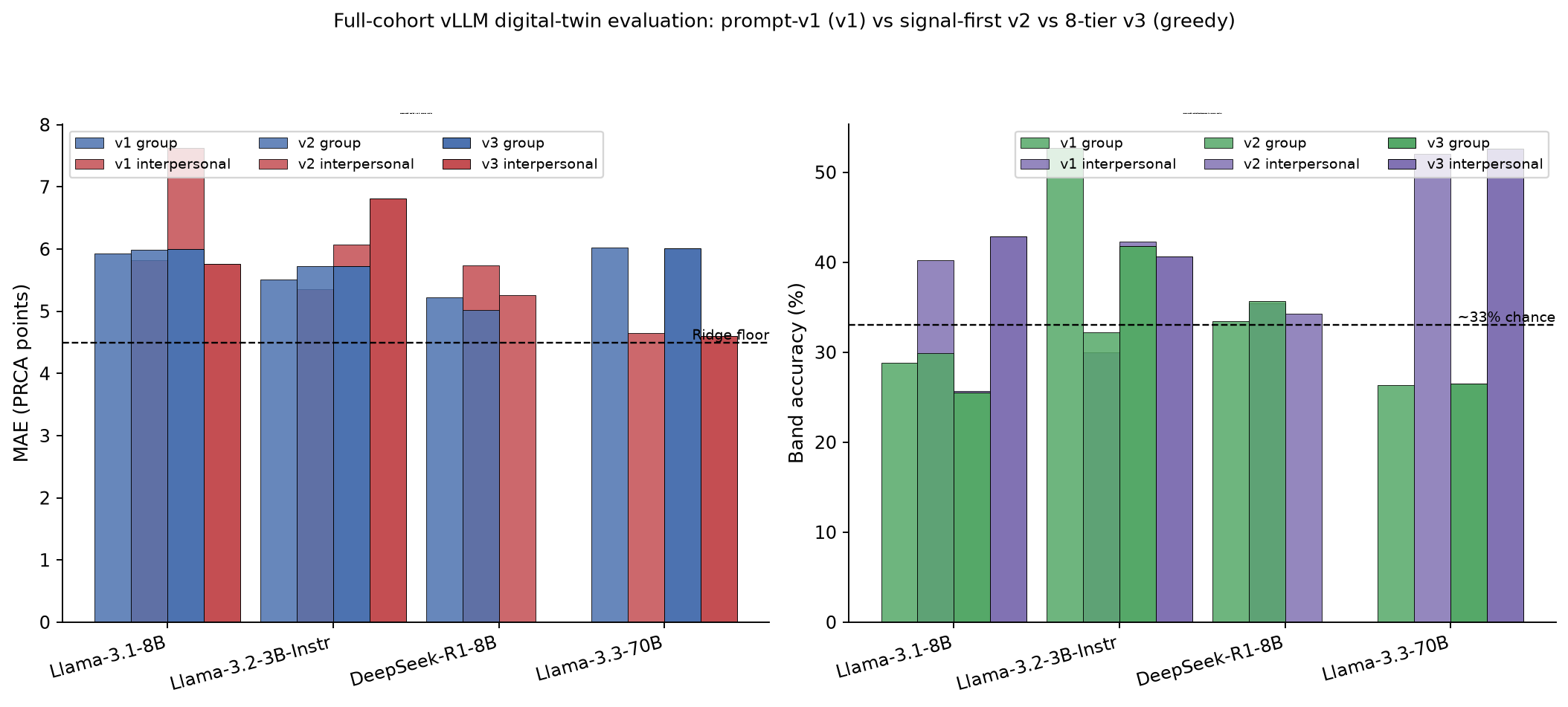
Short answer: None of the models is a high-fidelity digital twin ((Argyle et al., 2023; Grossmann et al., 2023)) (exact match single-digit). Among non-collapsed runs, DeepSeek-R1-Distill-Llama-8B wins group CA (5.22), Llama-3.2–3B-Instruct wins interpersonal MAE (5.35) and group band accuracy (52.7%), and Llama-3.1–8B-Instruct uniquely recovers interpersonal bands above chance at demos/geo (~52%) but collapses when transit is added (IP MAE 4.67 → 8.17). Llama-3.3–70B is a separate failure mode: ≈93% constant prior (18, 12) — do not rank it as a competitive twin despite a low IP MAE (4.65) that is an artifact of that prior. Employment (RQ1) is negligible for all; transit/full (RQ2–RQ3) help or hurt depending on model × subscale.
Figure Figure 1 summarizes cross-model MAE, band accuracy, and tier trajectories.
1.1 Head-to-head (all tiers pooled)
Table Table 2 pools all tiers for the head-to-head model comparison.
| Model | MAE group ↓ | MAE IP ↓ | Exact G | Exact IP | Band G | Band IP | Notes |
|---|---|---|---|---|---|---|---|
| Llama-3.1–8B-Instruct | 5.92 | 5.82 | 6.1% | 9.0% | 28.8% | 40.2% | Transit IP disaster |
| Llama-3.2–3B-Instruct | 5.51 | 5.35 | 9.1% | 7.7% | 52.7% | 30.0% | Best group bands |
| DeepSeek-R1-Distill-Llama-8B | 5.22 | 5.73 | 6.2% | 5.9% | 33.4% | 35.4% | Best group MAE; tier-stable |
| Llama-3.3–70B-Instruct | 6.02 | 4.65† | 6.4% | 12.4% | 26.3% | 52.0%† | †Constant prior; not person-tracking |
Non-collapsed models remain above the tabular Ridge floor (group MAE 4.49). Band accuracy vs ~33% chance: Llama-3.2 dominates group bands; Llama-3.1 leads interpersonal bands among models that still vary outputs (driven by demos/employment/geo, not transit).
1.2 RQ1–RQ3 pattern by model
Table Table 3 maps RQ1–RQ3 verdicts by model.
| RQ | Llama-3.1–8B | Llama-3.2–3B | DeepSeek-R1-Distill-8B | Llama-3.3–70B |
|---|---|---|---|---|
| RQ1 employment | Negligible | Negligible | Negligible / slight IP help | Null (collapsed) |
| RQ2 transit | Group slight help; IP disaster | Small group help; IP worse | Flat; no IP collapse | Null (flat collapse) |
| RQ3 full | Group band up; IP worse than demos | Best group MAE (5.29); IP mixed | Best IP MAE at full (5.42) | Negligible dips only |
Interpretation. Prompt-v1 transit text is a model-dependent hazard, not a universal aid. Llama-3.1 over-predicts interpersonal CA once mobility cues appear. Llama-3.2 and DeepSeek are more robust; DeepSeek is the most tier-stable, while Llama-3.2 is the best coarse group-band classifier among the three. Llama-3.3–70B shows that scale alone does not fix digital-twin recovery — without predictive variance, tier RQs are uninterpretable.
Conclusion. For prompt-v1 digital-twin evaluation on this cohort: prefer DeepSeek-R1-Distill-Llama-8B when minimizing group MAE, Llama-3.2–3B-Instruct when maximizing group band recovery / IP MAE, treat Llama-3.1–8B-Instruct as the cautionary transit-IP baseline that motivated packaging v2/v3, and treat Llama-3.3–70B as a mode-collapse cautionary case (not a scale win). No model yet closes the gap to classical ML (~4.5 MAE).
2 v2 / v3 follow-up (evaluated)
The archived v2/v3 exports (exports/v2/, exports/v3/) answer the questions left open above. Pooled metrics (Table Table 4):
| Prompt version | Model | MAE group | MAE IP | Transit IP | Notes |
|---|---|---|---|---|---|
| v2 (v2_enhanced) | DeepSeek-R1-Distill-8B | 5.02 | 5.26 | 5.09 | Best live result; no collapse |
| v2 | Llama-3.2–3B-Instruct | 5.73 | 6.07 | 5.77 | v1 IP win (5.35) not replicated |
| v2 | Llama-3.1–8B-Instruct | 5.99 | 7.63 | 8.23 | Collapse persists; demos IP 8.45 |
| v3 (greedy, 8 tiers) | Llama-3.1–8B-Instruct | 5.99 | 5.76 | 7.77 | Single-cue ablations 4.85–5.92 |
| v3 | Llama-3.2–3B-Instruct | 5.72 | 6.81 | 6.14 | — |
| v3 | Llama-3.3–70B-Instruct | 6.01 | 4.61† | 4.61† | †Constant prior persists |
Answers to the open questions:
- Do v2/v3 remove Llama-3.1’s transit IP collapse without harming DeepSeek / 3B? No for Llama-3.1. Signal-first packaging + mobility anti-bleed do not stop the collapse (transit IP 8.23 ≈ 8.17) and raise its base IP error (demos 4.67 → 8.45). DeepSeek improves under v2 (group 5.22 → 5.02; IP 5.73 → 5.26). Llama-3.2–3B’s v1 interpersonal advantage does not survive v2/v3 packaging.
- Is the collapse a packaging artifact or combination-specific? Combination-specific. Greedy v3 single-cue tiers leave IP stable (
v3_public_transit4.85,v3_voice5.82,v3_rideshare5.92); only the bundled mobility dump collapses it (7.77). - Can temperature / constrained decoding restore 70B variance? Not under greedy v3 (constant prior
(18, 12)persists); thev3_enhanced/large_modelpresets remain untested on 70B. - Signed-error / stereotyping slices across models? Still open — run
ca-personas stereotype-evalon each package’stables/02_evaluation_rowlevel.csv.
Open-text voice is not the collapse driver: v3_voice group MAE 5.64 / IP 5.82 for Llama-3.1 beat the kitchen-sink transit (6.07 / 7.77). On group MAE, v3_rideshare (5.86) is Llama-3.1’s best tier, matching tabular Q28 dominance.
Sources: data/vllm/llama3_1.md · data/vllm/llama32_instruct.md · data/vllm/deepseek-distilled/deepseek_v1.md · data/vllm/llama-3–70b/llama_70b.md · docs LLM baselines · github.com/Exios66/psych755-jjb
3 What questions or uncertainties remain?
Do v2 (signal-first) and v3 (rideshare / public-transit / voice ablations) remove Llama-3.1’s transit IP collapse without harming DeepSeek / 3B gains? Can temperature / constrained decoding restore 70B variance? Are signed-error / stereotyping slices (Sex, Age, Student, Employment) aligned across non-collapsed models?
4 What other analyses pair with this memo?
Per-model memos below unpack RQ tables and confusion matrices. Classical ceilings: docs/ml_baselines.md. Feature attributions (mock LLM era): feature_predictive_power_ml_llm.qmd. Prompt redesign rationale: docs/persona_prompt_efficiency.md.